Phone Ring Kickstand Guide 2026
Discover how to choose the perfect phone ring kickstand. Our guide covers materials, foldable phone compatibility, and top alternatives for a better grip.
 Editorial
A phone ring kickstand is one of those brilliantly simple accessories that, once you try it, you can't imagine living without. It’s a small, multi-functional gadget that sticks right onto the back of your phone, giving you a super-secure grip for one-handed use and a handy little stand for hands-free viewing. This single addition dramatically improves how you hold and use your device every single day.
The Swiss Army Knife for Your Smartphone
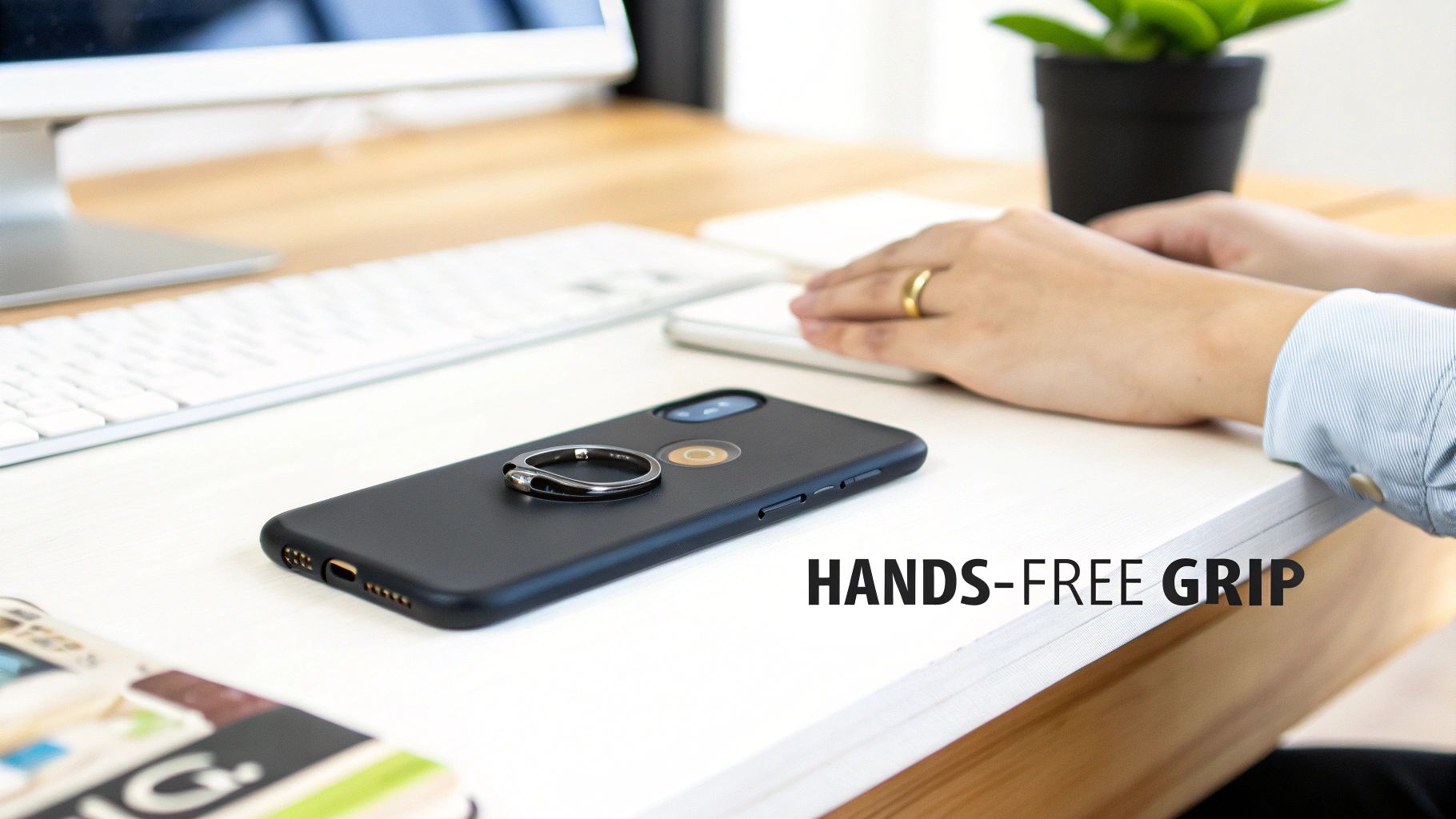
Think of a phone ring kickstand as the modern Swiss Army knife for your phone. It's a compact, unassuming tool that solves a bunch of common problems, turning from a simple accessory into an indispensable part of your daily routine. At its core, it pulls double duty, boosting both safety and convenience.
First and foremost, it’s an amazing grip enhancer. Just slip your finger through the ring, and you’ve got a solid anchor to your device. This makes juggling a big phone like a Samsung Galaxy Z Fold or Google Pixel Fold feel almost effortless, and it drastically cuts down on the risk of those heart-stopping accidental drops. Trying to take a selfie in a crowd or navigate a busy street suddenly feels a lot less precarious.
Second, it instantly flips into a surprisingly sturdy kickstand. The ring usually rotates a full 360 degrees and flips out, letting you prop your phone up in either portrait or landscape mode on pretty much any flat surface. This feature is an absolute game-changer for all sorts of situations.
Everyday Uses and Benefits
The real magic of a phone ring kickstand comes to life in dozens of little moments throughout your day. Once you get used to having one, you’ll genuinely wonder how you ever managed without it. Its versatility shines whenever you need an extra hand or just a better angle.
Here’s where it really makes a difference:
- Hands-Free Media Consumption: Binge-watch your favorite show, follow a recipe in the kitchen, or join a video call without having to awkwardly prop your phone against a stack of books.
- Enhanced One-Handed Use: You can comfortably reach all corners of your screen with just your thumb, even on bigger phones. Texting and scrolling on the go becomes so much easier.
- Improved Stability for Photos: That secure grip helps you take much steadier photos and videos, which means less blur and shakiness in your shots.
- Added Security: When your finger is through the ring, your phone is a lot harder for someone to snatch out of your hand in a crowd.
A phone ring kickstand isn't just another accessory; it's a functional upgrade that bridges the gap between your hand and your device, making the whole experience feel more natural and secure.
The Evolution of a Simple Idea
This clever little gadget has gone from being a niche item to a mainstream essential. It follows the same logic that made built-in stands common for larger devices, like you’d see in a folio with stand for iPad. It’s the perfect example of how a simple, well-designed idea can fundamentally improve our relationship with the tech we use every day.
How Materials and Designs Impact Your Choice
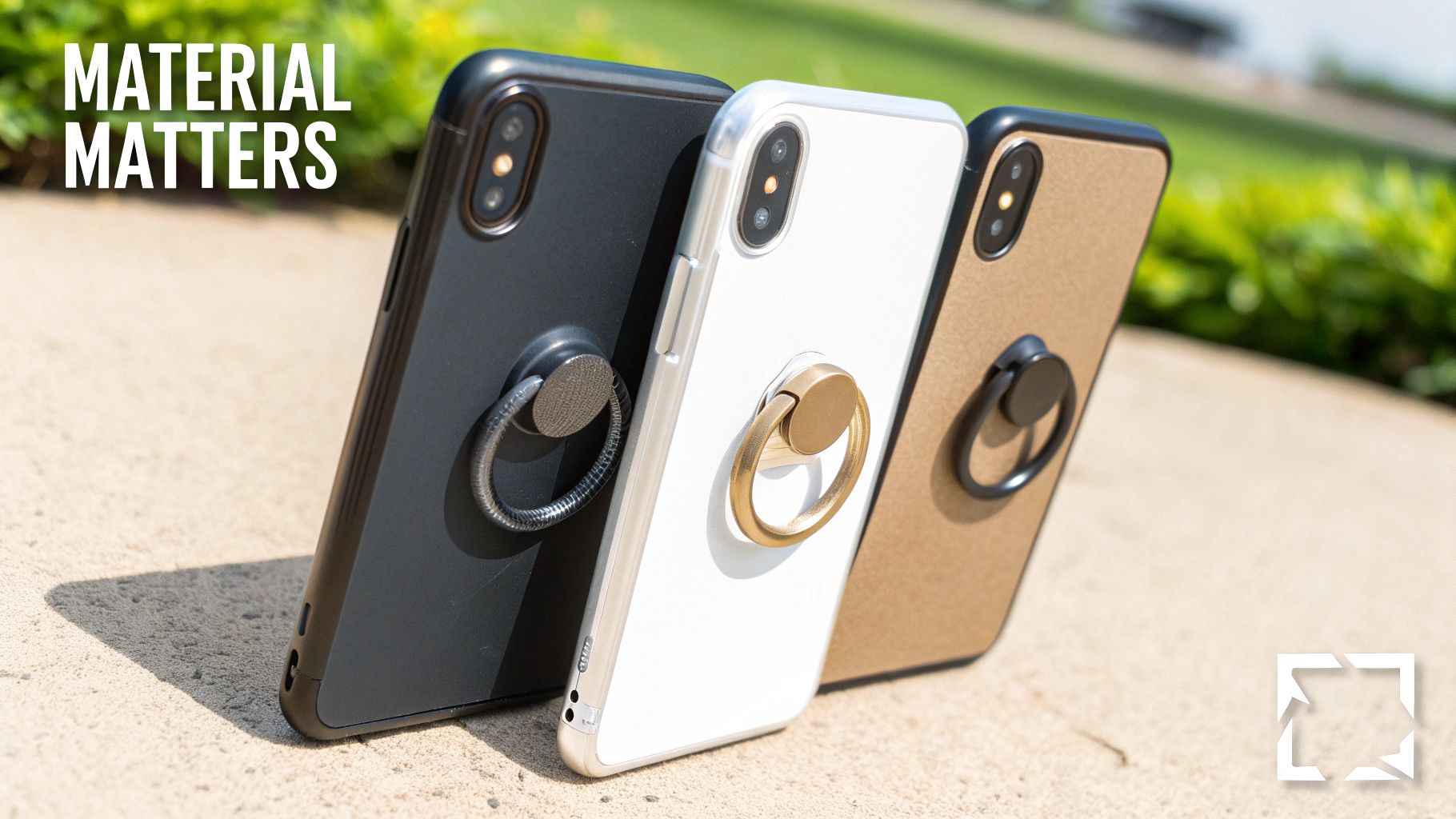
The material and design of a phone ring kickstand are so much more than just looks. They truly define its durability, how it feels in your hand, and its overall usefulness. From the satisfying click of a well-made hinge to the cool, premium touch of metal, the construction of your accessory directly shapes how you interact with your phone every day. That’s why getting a handle on the differences is key to finding the perfect match.
This choice is a bigger deal than ever, with the mobile accessories market absolutely booming. Valued at around USD 229.08 billion in 2024, it's projected to climb to an incredible USD 718.58 billion by 2035. This massive growth shows just how essential accessories like a reliable phone ring kickstand have become for protecting and getting the most out of our devices.
Choosing the right material isn't just about aesthetics—it’s about finding the right balance between weight, strength, and your daily experience.
Common Materials and What They Mean for You
What your phone ring kickstand is made of dictates how it performs under pressure. The market is dominated by two main camps: metals and plastics, and each comes with its own set of pros and cons.
The choice of material for a phone ring kickstand is a lot like choosing kitchen tools—it depends on what you need it for. Let's break down the common options.
Comparing Phone Ring Kickstand Materials
| Material | Pros | Cons | Best For |
|---|---|---|---|
| Zinc Alloy | Premium feel, durable, great for intricate designs | Heavier than plastic, can be more expensive | Users who want a sleek, modern look that feels substantial. |
| Aluminum | Lightweight, strong, rust-resistant | Can scratch more easily than steel | People who want durability without adding much weight. |
| Stainless Steel | Extremely tough, resists corrosion and scratches | Can be heavy, often has a more industrial look | Heavy-duty users who need maximum strength and longevity. |
| Polycarbonate | Very lightweight, impact-resistant, versatile colors | Can feel less premium, may lose hinge tightness over time | Anyone prioritizing a minimalist setup with minimal added weight. |
| ABS Plastic | Inexpensive, lightweight, easy to manufacture | Least durable, can crack under stress | Budget-conscious buyers or those who like to change accessories often. |
Ultimately, the best material comes down to your personal priorities. Metals like zinc alloy and stainless steel offer that long-lasting, heavy-duty reliability, while plastics provide a lightweight and often more colorful alternative.
Exploring Different Kickstand Designs
Beyond what it's made of, the actual design of the kickstand plays a massive role in how versatile it is. The shape and mechanics determine everything from a simple grip to a multi-functional tool.
You'll generally run into a few common designs:
- Minimalist Rings: These are your simple, elegant rings. They give you a secure grip and basic kickstand function, designed to be as slim and unobtrusive as possible.
- Multi-Angle Kickstands: These are the workhorses. They often have multiple joints or a swiveling base, letting you prop your phone up at different angles for the best view in any situation.
- Magnetic Designs: Built for total convenience, these rings attach to your phone with powerful magnets, often making them MagSafe compatible. This means you can pop it off in a second to use a wireless charger, giving you the best of both worlds.
For instance, a business professional using a Google Pixel Fold might go for a slim, low-profile aluminum ring. It gives them hands-free capability for video calls without adding bulk. On the other hand, someone with an active lifestyle using a rugged case might need a beefy, multi-jointed stainless steel stand that can securely prop up a heavier device from any angle.
Using a Kickstand with Foldable Phones and Wireless Charging
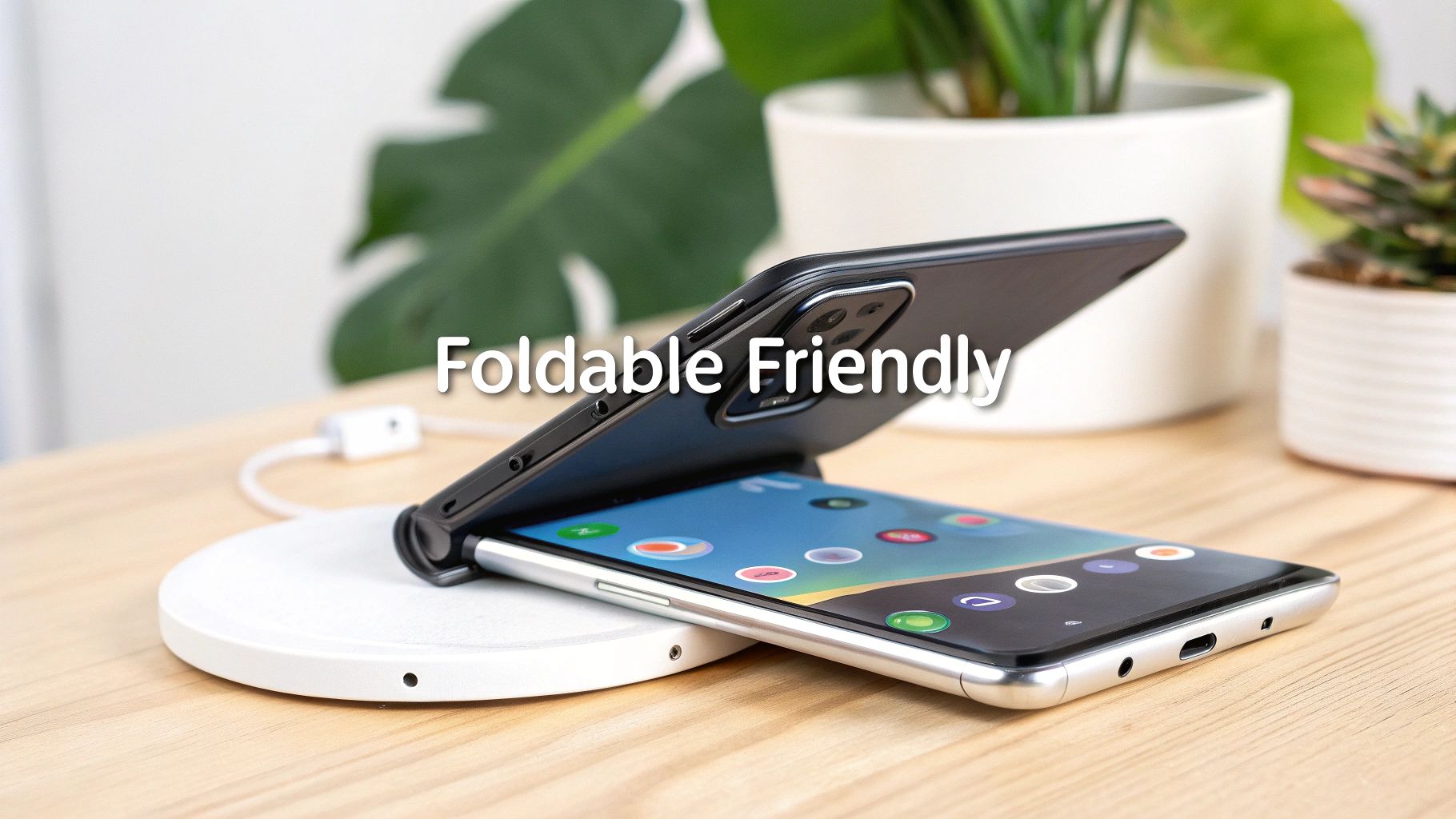
Foldable phones like the Samsung Galaxy Z Fold and Google Pixel Fold are incredible pieces of tech, but their unique design presents a few puzzles for accessories. Sticking a phone ring kickstand on one isn't as straightforward as it is with a normal phone, especially when you have to think about that all-important hinge and the convenience of wireless charging.
It really boils down to two main hurdles: placement and power. Where do you even put an accessory on a phone that literally folds in half? And how do you keep wireless charging working when most rings are made of signal-blocking metal? Luckily, the accessory world is clever, and there are now some great answers to both of these questions.
Navigating the Foldable Phone Landscape
The hinge is everything on a foldable phone. If you slap a standard adhesive ring in the wrong spot, you could stop the phone from opening and closing properly. Even worse, it could create a lopsided, unstable feel when you unfold it into that beautiful tablet screen.
Weight distribution is the other big thing to watch. A phone like the Galaxy Z Fold is a lot heavier when it's open, and a poorly placed kickstand might just cause it to topple over in landscape mode. The goal is to find that perfect sweet spot that gives you a stable stand whether your phone is folded up or opened wide.
Here are a few proven strategies to get it right:
- Off-Center Placement: Forget the dead center. The best spot is usually on one of the back panels, away from the camera bump. This keeps the ring clear of the hinge's path.
- Case-Integrated Solutions: This is often the simplest and most reliable route. Many cases made just for foldables have a kickstand built right in or a specific spot designed for one, taking all the guesswork out of the equation.
- Two-Piece Rings: Some newer, more innovative designs have a base that comes in two parts. You place one on each side of the fold, giving you a much more balanced and sturdy stand when the device is open.
By thinking about where to put it first, you can make sure your kickstand adds function without messing with the main reason you bought a foldable in the first place.
The Wireless Charging Dilemma
This is where things can get tricky. Standard wireless charging (the Qi tech in most phones) relies on a magnetic field between a coil in the charging pad and a coil in your phone. Stick a piece of metal in between, and you break that connection. The charge just won't get through.
The physics are simple: most metal phone ring kickstands will block a wireless charger from working. The metal absorbs the energy, often converting it to heat, and interrupts the connection between the charger and your phone’s battery.
For a long time, this meant choosing between a handy kickstand and the ease of wireless charging. Thankfully, that's not the case anymore. Accessory makers have come up with several smart workarounds that give you the best of both worlds.
Solutions for Seamless Power
If you can't live without just dropping your phone on a pad to charge, don't worry. Accessory brands have engineered some brilliant ways to get around the metal-blocking problem. One of these options is sure to fit your setup perfectly.
Here are the most effective solutions out there today:
- Detachable Magnetic Rings: This is hands-down the most popular and elegant fix. These rings snap onto a MagSafe-compatible case. The magnetic pull is plenty strong for a secure grip and stand, but you can just pop the ring off when it's time to hit the wireless charger.
- Slide-and-Remove Designs: Some non-magnetic versions use a clever sliding track. The ring itself can be slid off its adhesive base plate, letting you remove the metal part without having to peel the whole thing off your phone.
- Ultra-Thin "Wireless Charging Friendly" Rings: A new wave of kickstands is hitting the market, made with special non-metallic materials or ultra-thin metal designs that have a "pass-through" gap. Performance can be a bit hit-or-miss, but they're built to minimize interference. To see how these work with specific models, you can learn more about how a phone ring kickstand impacts Galaxy wireless charging capabilities in our detailed guide.
For anyone with a premium device, especially a foldable, a detachable magnetic ring is almost always the way to go. It offers the most flexibility, giving you a solid grip when you need it and effortless charging when you don't.
How to Install and Remove Your Kickstand Safely
Getting your new phone ring kickstand to stick properly isn’t rocket science, but it’s not just a slap-on-and-go deal either. Think of it like applying a high-quality screen protector—the prep work makes all the difference. Rushing it can lead to a weak bond, and nobody wants their phone taking a nosedive because the grip gave way.
This walkthrough will give you the confidence to get a rock-solid application on the first try, ensuring your kickstand stays put and your phone stays safe. We'll cover everything from getting the surface ready to popping it off later without leaving a scratch.
The Installation Process Step by Step
Before you even think about peeling that little plastic film off the adhesive, a bit of prep is in order. Most of the time, when these things fail to stick, it's because the surface was dirty or the adhesive wasn't given time to properly bond.
Follow these steps for a connection that won't quit:
- Clean the Surface Thoroughly: Grab the alcohol wipe that came in the box (or just use a clean cloth with some isopropyl alcohol) and give the back of your phone or case a good wipe-down. This gets rid of any oils, dust, or fingerprints that kill adhesion. Let it air dry completely.
- Find the Perfect Spot: Don't commit just yet. Hold the ring on the back of your phone and see what feels right. If you’re using it mainly for grip, find where your index finger naturally wants to rest. For the best stability as a stand, you’ll want to place it slightly lower than the center.
- Peel and Stick with Precision: Now, carefully peel the film off the adhesive pad. Line up the kickstand in your chosen spot and press down firmly for at least 30 seconds. Make sure you apply even pressure across the entire base to get a good, flat seal.
- Let It Cure: This is the step everyone skips, and it's the most important one. The adhesive needs time to set up and form a permanent bond. Do not use the ring or kickstand for at least 24 hours.
That curing period lets the adhesive chemistry do its magic, maximizing its strength so it can handle all the pulling, twisting, and propping up you're going to put it through.
A common mistake is trying to stick a kickstand onto a textured or soft silicone case. That adhesive needs a smooth, hard, non-porous surface to grab onto. A flexible, soft-touch silicone case just doesn't provide the solid foundation for a lasting connection.
Safe Removal Without Damaging Your Device
Eventually, you'll want to take the kickstand off, maybe for a new case or a phone upgrade. The trick here is patience. Trying to rip it off with brute force is a great way to damage your phone’s finish or, worse, crack the back glass.
Instead of pulling, try this much gentler approach:
- Gentle Heat: Use a hairdryer on its lowest heat setting. Hold it a few inches away from the ring for about 15-20 seconds. This is just enough to soften the adhesive without getting anything dangerously hot.
- Dental Floss or a Plastic Card: Take a piece of dental floss or a thin plastic card (a gift card works perfectly) and slide it under one edge of the kickstand’s base.
- Sawing Motion: Gently work the floss or card back and forth with a light sawing motion. This will slice right through the softened adhesive, and the kickstand should lift off easily without any prying.
Beyond just securing your phone, it's always good practice to keep it powered up for whatever the day throws at you. You can learn more about how to charge your phone with a portable charger for those times you're away from an outlet for a while. The demand for these kinds of simple, effective accessories is massive. In fact, the global market is projected to grow from USD 21.20 billion in 2025 to a staggering USD 42.28 billion by 2035.
Finding the Right Kickstand for Professional and Heavy-Duty Use
Let’s be honest, a standard phone ring kickstand isn’t going to cut it for everyone. If you’re a professional hopping on video calls all day or someone working in a tough environment, you need something more. In these situations, a flimsy plastic hinge or weak adhesive is just asking for trouble. The focus shifts from casual convenience to unwavering reliability.
A true heavy-duty phone ring kickstand is built differently from the ground up. Forget basic plastic—these models are typically machined from reinforced aluminum or stainless steel. The most critical part, the hinge, is where you really see the difference. They're often tested to handle thousands of rotations without getting loose, making sure your phone stays propped up at the perfect angle, every single time.
Key Features for Demanding Lifestyles
When your job or hobbies put your gear through the wringer, you need a kickstand that can keep up. Think about bulky, ruggedized cases on heavy devices like a Galaxy Z Fold—the adhesive bond becomes absolutely critical. Heavy-duty models use powerful adhesives meant to create a permanent-like connection on hard, non-porous surfaces, giving you the strength needed to support all that extra weight.
When you're shopping for a kickstand that can handle rugged use, keep an eye out for these features:
- Reinforced Hinge: You want a beefy hinge made from metal that gives a stiff, reliable hold and won't loosen up over time.
- Durable Materials: Look for zinc alloy, aluminum, or stainless steel construction. These materials can take a few bumps and drops without cracking.
- Powerful Adhesive: A strong, reputable adhesive, often from a brand like 3M, is non-negotiable for a secure bond to your phone or case.
- Multi-Angle Support: The kickstand should be able to lock securely at various angles. This gives you the flexibility for different tasks, from typing to watching videos.
This decision tree nails the first, most important step for any installation: ensuring a strong bond right from the start.
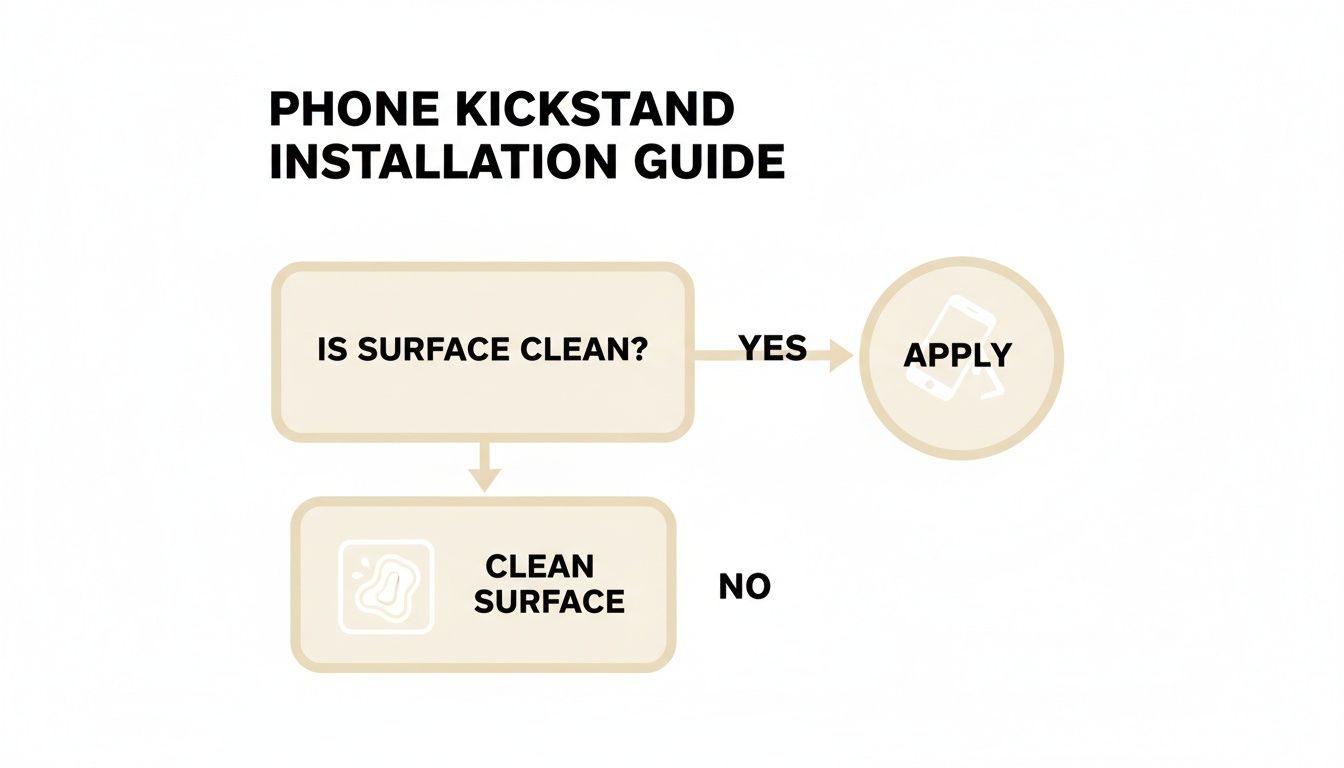
The visual drives home a fundamental rule: a clean surface is the only way to get a secure, long-lasting bond from the adhesive.
Professional Polish Meets Practical Function
For professionals, a phone kickstand has to walk a fine line between sophisticated design and raw utility. A bulky, industrial-looking accessory can completely ruin a polished, professional image. The best choice is often a low-profile model with a sleek, minimalist look that complements the design of a premium smartphone. These designs give you that essential hands-free function for video conferences or reviewing documents without adding a bunch of clutter.
A well-chosen phone ring kickstand for a professional isn't just a gadget; it's a productivity tool that integrates seamlessly into a mobile workflow, offering stability and convenience without sacrificing style.
This move toward specialized, high-function accessories is happening everywhere. Just look at the global smart rings market. It was valued at USD 279.3 million in 2024 and is expected to explode to USD 2,090.9 million by 2034. That incredible growth shows a real hunger for smart, integrated accessories that make our devices more powerful and easier to use. You can read the full research on the smart rings market to see just how big this trend is. It proves people are more than willing to invest in quality tools that fit their specific, and often demanding, lifestyles.
Comparing the Best Alternatives to Phone Rings
While a phone ring kickstand is a fantastic, multi-talented tool, it’s not the only show in town. The market is packed with clever solutions for getting a better grip on your phone and propping it up for a hands-free view. Knowing how these alternatives stack up is the key to finding the perfect accessory for your daily grind.
Each option comes with its own unique trade-offs. You might be balancing grip security against stand flexibility, or slimness against features like wireless charging. Let's break down the most popular alternatives to see where a phone ring really shines and where another solution might be a better fit.
Cases with Integrated Kickstands
One of the most straightforward alternatives is a case that comes with a kickstand built right in. These cases give you a seamless, all-in-one package, so you never have to worry about sticking on a separate accessory. The stand is always there when you need it and folds away neatly when you don’t.
But that convenience has one major catch: fixed placement. You’re stuck with wherever the manufacturer decided to put the stand. That means you're locked into their chosen position and viewing angles. It's great for simplicity, but it completely lacks the customizable comfort you get from placing a phone ring kickstand exactly where your hand needs it. If you want to explore this route, you can find a great phone case with a built-in stand designed for your specific device.
PopSockets and Similar Grip Accessories
PopSockets are probably the most famous grip alternative out there. Their smart, collapsible design makes them incredibly low-profile when you’re not using them. They offer a comfortable way to hold your phone by letting you slide your fingers between the base and the pop-out top, and they can double as a kickstand—though it can sometimes be a bit wobbly.
The real difference comes down to the style of grip and how stable the stand is.
- Grip: A PopSocket gives you a more relaxed "pinch" grip. In contrast, a phone ring provides a secure loop your finger goes through, which offers far better protection against accidental drops.
- Stand Function: A phone ring kickstand, usually built from metal with a solid hinge, is almost always a more stable and adjustable stand. This is especially true for today's bigger, heavier phones.
For anyone whose main worry is preventing a catastrophic drop, the secure loop of a phone ring kickstand often provides a lot more peace of mind than the casual grip of a collapsible accessory.
Magnetic Wallet Stands
Magnetic wallet stands, especially the ones designed for MagSafe, are the ultimate minimalist accessory. They roll three functions into one sleek package: a grip, a stand, and a cardholder. This makes them a brilliant choice for anyone looking to combine their everyday carry items into a single unit. Plus, the magnetic attachment means you can just pull it off for easy wireless charging.
The trade-off? Added bulk and weight. A wallet stand makes your phone noticeably thicker, and that’s not a compromise everyone is willing to make. While they're incredibly versatile, they often provide less ergonomic comfort than a dedicated phone ring kickstand that’s been designed purely for how it feels in your hand.
Phone Stand and Grip Alternatives Compared
So, how do all these options truly stack up against each other? Each one serves a different kind of user, from the minimalist to the power user who needs maximum security. This table breaks down the key features at a glance.
| Solution Type | Grip Security | Stand Versatility | Wireless Charging | Best For |
|---|---|---|---|---|
| Phone Ring Kickstand | High (Secure loop) | High (360° rotation) | Sometimes (Removable) | All-around security and stand flexibility. |
| Integrated Case Stand | None (Case grip only) | Low (Fixed angles) | Yes (No interference) | Simplicity and an all-in-one solution. |
| PopSockets | Medium (Pinch grip) | Medium (Limited angles) | Yes (Removable top) | Casual grip aid and basic stand use. |
| Magnetic Wallet Stand | Medium (Bulkier hold) | Medium (Often limited) | Yes (Fully removable) | Consolidating wallet and phone essentials. |
Ultimately, there's no single "best" choice for everyone. A phone ring kickstand wins for its unbeatable combination of a secure grip and a super-flexible stand. However, if your priority is consolidating your pockets or having a simple, built-in solution, one of the alternatives might just be your perfect match.
Frequently Asked Questions About Phone Ring Kickstands
Even after you get the hang of a phone ring kickstand, a few practical questions always seem to pop up. Getting straight answers to these common worries can be the difference between loving your new accessory and feeling frustrated. Let's tackle the most frequent queries head-on.
We'll cover everything from trying to move your kickstand to a new phone to making sure it comes off cleanly without leaving a mark.
Can I Reuse a Kickstand on a New Phone or Case?
Most phone ring kickstands are held on with a seriously powerful, single-use 3M VHB adhesive. It’s designed to create a permanent bond. While you might be tempted to peel it off and stick it on your new phone, trying to reposition it almost always ruins the adhesive. That creates a huge risk of it failing later, sending your phone for a nasty fall.
For your phone's safety, the best practice is simple: always start with a fresh kickstand for a new phone or case. If you're absolutely determined to try a transfer, you'll need to buy a new, perfectly sized adhesive pad—but only after you've painstakingly scraped every last bit of old sticky residue from the ring's base.
Will a Phone Ring Kickstand Damage My Phone?
If you do it right, a kickstand won't cause any damage to your phone or case. The secret is patience, not brute force. Yanking on the ring can put a ton of stress on your phone’s back glass or completely wreck the finish on your case.
Instead, take a deep breath and follow these much safer steps:
- Gently warm the adhesive using a hairdryer on its lowest setting for about 15–20 seconds. This just softens it up a bit.
- Slide a thin, non-metal tool like a piece of dental floss or a plastic gift card under the base of the kickstand.
- Use a slow, sawing motion to gently slice through the softened adhesive. The kickstand should lift off cleanly without a fight.
Are Magnetic Kickstands Strong Enough for Heavy Foldable Phones?
A high-quality magnetic ring, especially one built for the MagSafe ecosystem, can be incredibly strong. But its real holding power is a partnership—it depends just as much on the strength of the magnets in your phone case as it does on the ring itself.
For a heavier device like a Samsung Galaxy Z Fold, it is absolutely critical to pair a kickstand from a reputable brand with a premium magnetic case. That synergy creates a secure lock that can safely support the phone's weight, whether it’s folded shut or opened up into a tablet.
Trying to save a few bucks with a generic magnetic case for a heavy foldable is a big gamble. The connection might not be strong enough, and you risk the phone detaching when you least expect it.
At FoldifyCase, we specialize in accessories engineered to meet the unique demands of foldable phones. Explore our collection of premium cases and magnetic accessories designed for a perfect fit and uncompromising protection. Find the ideal solution for your device at https://www.foldifycase.com.
Shop FoldifyCase foldable phone cases
Precision cases for Galaxy Z Fold & Z Flip — full MagSafe, S-Pen ready, zero bulk.